
3 Things That Determine Whether Your Home Sale Is Smooth or Frustrating
Posted on August 26, 2026 Leave a Comment
A straight-talk guide for sellers in Lodi, Stockton, and the Central Valley.
By Jesse J. Rivas, Realtor® | Keller Williams Central Valley | Mid-Year 2026
Every week I talk to homeowners who are thinking about selling. And I’ll be honest with you: the difference between sellers who have a smooth, profitable experience and those who end up frustrated almost always comes down to the same three things.
In a market like this one, balanced, selective, more thoughtful than in the frenzy years, these three things matter more than ever. Let me walk you through each one.
| 01 | Price It Right From the Start Your pricing strategy is the single biggest factor in how your sale goes. A sharp launch price is not a sign of desperation. It’s a strategy. |
This is the mistake I see sellers make over and over: they want to test the market at a high price and see what happens. Here’s what actually happens: you sit on the market. Buyers see the days ticking up and assume something must be wrong with the house. Eventually you have to drop the price. And you end up netting less than if you had priced it correctly from day one.
With homes averaging 40 to 47 days on the market across our area right now, this is a real and costly mistake. Buyers are doing their homework. They’re comparing your home to everything else available at your price point. They know the market.
What wins: Pricing based on real, current data, not what your neighbor got in 2022, not what Zillow’s algorithm says, not what you need to clear for your next purchase. What the market is actually willing to pay, right now.
That’s the conversation I have with every seller I work with. Not the number you want to hear, the number that gets you to the closing table.
| 02 | Presentation Wins Every Time The homes selling fastest right now have one thing in common: they’re ready. Most buyers have their first showing online, before they ever set foot in your home. |
Here’s something I always tell sellers: the first showing most buyers do is on their phone. If your listing photos don’t stop the scroll, they move on. Simple as that. We’ve all done it.
I walk through every home I list and give sellers a specific prep list. It doesn’t have to be expensive. But the right preparation makes a real difference in how fast your home sells and for how much.
Here’s what matters most:
- Clean and declutter — Buyers need to picture themselves living there, not around your stuff.
- Fresh paint where needed — One of the highest-ROI updates you can make before listing.
- Curb appeal — Cleaned-up landscaping and a welcoming front entrance set the tone before anyone steps inside.
- Professional photography — This is non-negotiable in today’s market. Phone photos don’t cut it.
- Staging key rooms — Living room, primary bedroom, kitchen. It doesn’t have to be everything.
The homes that are sitting 47+ days on the market right now are almost always the ones where presentation was treated as an afterthought. Don’t let that be your home.
| 03 | Don’t Go It Alone In a compressed, selective market, strategy matters more than it did in 2021. The difference between a home that sells and one that sits often comes down to who’s in your corner. |
I’m not saying this just because I’m a Realtor. The data backs this up. In 2021, when inventory was at historic lows and buyers were waiving contingencies to compete, almost anything sold quickly. That’s not this market.
Today’s buyers have options. They’re being thoughtful. They’re negotiating. And the sellers who are getting the best outcomes have someone who knows how to navigate that, someone who understands pricing conversations, knows the local competition, can position your home correctly, and can negotiate effectively when it counts.
What you deserve: Someone who knows this market, is honest with you about what your home is worth, and is going to work hard to get you to the closing table.
I’ve personally bought six homes, sold four, and yes, lost one to foreclosure. I know what’s at stake when you sell. I bring all of that experience to the table every time I work with a seller.
The Opportunity Is Real — You Just Need the Right Plan
The Central Valley market in 2026 isn’t the frenzy of 2021. But it’s also not the crash of 2008. It’s a market where serious buyers are out there every single week, with over 100 closings per week in San Joaquin County last year alone.
Lodi prices are up 6.8% year-over-year. Inventory is down 12%. Stockton saw 189 homes sell in a single month. Tracy is up 22% in sales volume. The opportunity is real.
You just need to approach it with the right plan.
| Let’s Talk About Your Home I offer free, no-pressure home valuations across Lodi, Stockton, Tracy, Manteca, and the Central Valley. You’ll walk away with a clear picture of what your home is worth today and what a sale would actually look like for your family. Text or DM “VALUE” — I’ll reach out personally. Zero obligation. 📞 (510) 506-3800 | ✉ JesseRivas@KW.com | 📸 @jesse_rivas_realty | 🌐 JesseJRivas.com |

The Real Numbers: Mid-Year 2026 Central Valley Market Report
Posted on August 25, 2026 Leave a Comment
What’s actually happening in Lodi, Stockton, Tracy & Manteca, and what it means for your next move.
By Jesse J. Rivas, Realtor® | Keller Williams Central Valley | Mid-Year 2026
If you own a home in Lodi, Stockton, or anywhere in the Central Valley and you’ve been thinking about selling, here’s my promise to you: I’m going to give you the real numbers. Not the headlines, not the hype, just what’s actually happening in your neighborhood right now, and what it means for your next move.
I pulled the actual mid-year market data for San Joaquin County, city by city, and I’m going to break it all down in plain English so you can make a smart decision for your family.
First, The Big Picture: San Joaquin County
Before we look at your specific city, here’s some important context about the county as a whole, because it changes everything about how you think about this market.
Here’s a stat that surprises almost everyone I tell it to:
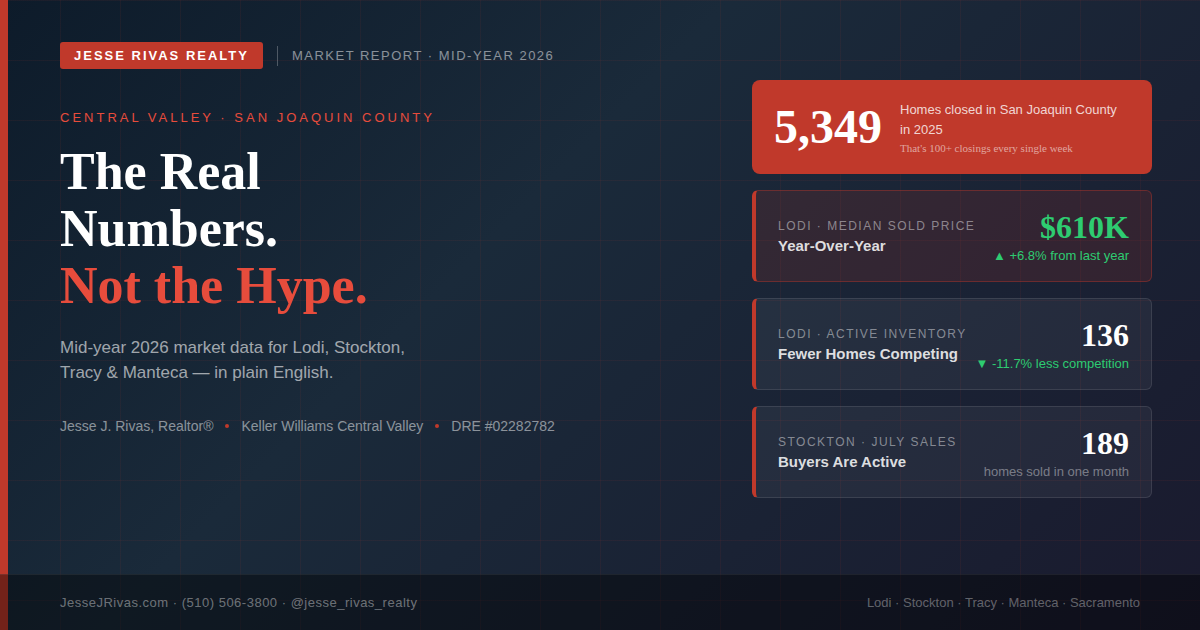
| 5,349 Homes Closed in San Joaquin County in 2025 — That’s 100+ closings every single week. |
If someone told you nobody’s buying right now, that’s just not true. Over 5,000 families bought or sold homes in this county last year. The market has not stopped.
Now, is it the wild ride of 2021 and 2022, when homes were getting 20 offers in 48 hours? No. It’s not that market. But for a seller who knows what they’re doing, this market is still very workable. Let me show you why.
The Three Eras of San Joaquin County
To understand where we are today, it helps to understand where we’ve been:
- Boom & Dislocation Era (2004–2010)
- Normalized Activity Era (2013–2021)
- Today’s Compression Era (2022–Present)
We’ve gone through the bubble, the crash, the long recovery, and the pandemic frenzy. Now we’re in what the data calls a compression era: fewer total transactions, but prices are holding, and in some cities, actually going up.
What compression means for sellers: the buyers who are out there right now are serious. They’re not tire-kickers. Homes that are priced right and show well are still selling. The market is just more selective now, and selective markets reward sellers who do things right.
Lodi: One of the Strongest Markets in the County
If you own a home in Lodi, you’re sitting in one of the best-performing markets in San Joaquin County right now. Here’s what the numbers show when we compare July 2025 to July 2026:
| $610K Median Sold Price | +6.8% Year-Over-Year | 136 Active Inventory | -11.7% Inventory Change |
| 53 Sold Units (July) | +6% Units Change | 47 days Days on Market | Balanced Market Trend |
What This Means for Lodi Sellers
Home prices in Lodi are up nearly 7% compared to a year ago. That’s meaningful money. On a $575,000 home, a 7% increase is over $40,000 in equity that wasn’t there last year. That’s a significant jump.
At the same time, inventory, meaning the number of homes competing with yours for buyers, is actually down 12%. Fewer homes on the market is great news for sellers. You’re dealing with less competition.
Days on market did tick up from 40 to 47, meaning homes are taking about a week longer to sell than last year. Here’s my honest take on that: this is not a set-it-and-forget-it market. You can’t just stick a sign in the yard and expect 2021 results.
What’s Winning in Lodi Right Now
- A polished launch: great photos, smart staging, right pricing from day one
- Homes that are priced accurately and show well are capturing buyer demand quickly
- The homes sitting at 47+ days are the ones that are overpriced or need visible work
Prices are up. Inventory is down. If you’ve been on the fence about selling, the data is genuinely in your favor right now. This could be one of the best windows Lodi sellers have seen in a while.
Stockton: Stable, Active, and Working for Smart Sellers
Stockton tells a slightly different story than Lodi, but it’s still a story that works for sellers. Here’s the mid-year data:
| $445K Median Sold Price | +0.7% Year-Over-Year | 499 Active Inventory | +4.6% Inventory Change |
| 189 Sold Units (July) | Flat Units Change | 40 days Days on Market | Balanced Market Trend |
What This Means for Stockton Sellers
Prices in Stockton are holding steady, up slightly from a year ago, but essentially flat. In an environment where interest rates have kept many buyers on the sidelines, flat prices mean your home’s value is being protected. That’s actually good news.
Where Stockton differs from Lodi is inventory: buyers here have a few more options to choose from. That means homes that stand out through condition, presentation, and pricing are the ones that sell.
189 homes sold in Stockton in July alone. Buyers are absolutely active. They’re just being careful, comparing options, and not going to overpay for a home that isn’t ready.
What I Tell Every Stockton Seller
“Condition and pricing are everything. If your home is move-in ready and priced where the market actually is, not where you wish it was two years ago, you will find a buyer. No doubt about it.”
The buyers are out there. You just have to give them a reason to choose your home.
Tracy & Manteca: Quick Snapshots
Tracy — One of the Stronger Stories in the County
| $724K Median Sold Price | +3.4% Price Change | +22% Sold Units | Balanced Market Trend |
Tracy is one of the stronger performers in the county right now. Median sold prices are up 3.4%, and sold units jumped over 22% year-over-year. It’s a growing community with a lot of new construction, and the data leans seller-friendly.
Manteca — Growing Values, Patient Buyers
| $640K Median Sold Price | +4.1% Price Change | +17% Sales Volume | Mixed/Balanced Market Trend |
Manteca is showing solid growth; values are up 4.1% to $640K, and sales volume jumped nearly 17%. However, homes are taking about 12 days longer to sell than last year, and list prices have softened a bit. The message for Manteca sellers: don’t get aggressive on price. Buyers are value-sensitive, but demand is still active.
The Bottom Line
Every city behaves differently. Every neighborhood behaves differently. That’s exactly why countywide averages only tell part of the story; you need someone who knows your specific market.
But here’s what holds true across all of San Joaquin County right now: the market is alive. Over 5,300 homes closed here last year. Buyers are out there and they’re active. The opportunity is real. You just need to approach it with the right plan.
| Find Out What Your Home Is Worth — Free, No Pressure I do free home valuations for homeowners across Lodi, Stockton, Tracy, Manteca, and the Central Valley. You’ll walk away with a clear picture of where your home stands, zero obligation. Text or DM me “VALUE” and I’ll reach out personally. 📞 (510) 506-3800 | ✉ JesseRivas@KW.com | 📸 @jesse_rivas_realty | 🌐 JesseJRivas.com |
Jesse J. Rivas, Realtor® | DRE No. 02282782 | Keller Williams Central Valley | Broker DRE No. 02324551
Who Is Jesse Rivas? A Real Estate Agent Who Has Been Where You Are
Posted on August 13, 2026 Leave a Comment
There are a lot of real estate agents out there. So why work with Jesse Rivas?
Because Jesse isn’t just an agent; he’s someone who has lived through the same financial pressures, life transitions, and real estate challenges that many of his clients face. He understands that buying or selling a home isn’t just a transaction. It’s one of the most important decisions of your life. And he treats it that way.
Rooted in the Central Valley, Connected Across the Bay
Jesse is a licensed real estate agent based in Lodi, California, serving clients throughout the Central Valley and East Bay. Whether you’re a first-time buyer, a seller ready to move on, or someone navigating a difficult financial situation with your home, Jesse brings the kind of grounded, honest guidance that only comes from real-life experience.
A Background Built on Hard Work and Education
Before real estate, Jesse spent over 23 years in the heavy civil construction industry, working his way from field project sites to senior management roles in HR, risk, and operations and compliance. He’s held positions that required strategic thinking, strong communication, and the ability to work with people from all walks of life. Those skills translate directly into how he serves clients today.
Jesse holds a Bachelor’s Degree in Business and an Executive MBA. He’s currently completing his Doctorate in Business not because a degree makes him better than anyone else, but because education has always opened doors he never expected. He believes in backing up what he does with both knowledge and integrity.
Why Real Estate? Because It Matters.
Jesse has purchased and sold many homes throughout his life, and he’s experienced both sides of what it means to have a great agent and what it means to go through it without one fully in your corner. That experience is what drives him.
“I know what it means to have a good agent on your side, and I know what it means to have an agent who doesn’t have your best interest at heart. It matters. That’s why I do what I do.”
His core values are simple: work hard, be transparent, be honest, and build lasting relationships. Real estate isn’t just about closing a deal; it’s about helping people move forward in their lives.
A Story Worth Sharing
Jesse knows firsthand what it feels like to lose a home. He lived through the foreclosure crisis of 2007 and came out the other side with a completely different perspective on real estate, financial resilience, and what clients really need from an agent. His story isn’t a brag. It’s proof that no matter where you are right now, there’s a path forward.
He’ll be sharing that journey here on this blog: the foreclosure, the rebuilding, the lessons learned, and how he went from losing his home to buying again and building a real estate career around helping others do the same.
Let’s Connect
If you’re thinking about buying, selling, or you’re not sure where to start, Jesse wants to hear from you. No pressure, no sales pitch. Just a real conversation about where you are and where you want to go.
Visit jesserivas.kw.com to learn more or reach out directly. Jesse proudly serves clients throughout Lodi, the Central Valley, and the East Bay.
Jesse Rivas | Jesse Rivas Realty | Keller Williams
📞 Call or Text: (510) 506-3800 | ✉ jesserivas@kw.com | 🌐 jesserivas.kw.com

Lodi Real Estate Market Update: What’s Happening in 2026
Posted on August 2, 2026 Leave a Comment
Published by Jesse J. Rivas | Jesse Rivas Realty | Keller Williams
If you own a home in Lodi or are thinking about buying or selling, here’s the honest, ground-level view of where the market stands right now.
Inventory Remains Tight
There are more buyers looking than there are good homes available in Lodi, especially in the sub-$500K range. Limited supply continues to support home values and gives well-prepared sellers leverage. Homes that are priced correctly and show well are still moving. Overpriced homes are sitting.
Buyers Are Adjusting to Interest Rates
Rates have been a consistent conversation in real estate over the past few years, and that continues in 2026. But in Lodi, the price-to-value relationship still makes ownership more attainable than in most California markets. Many buyers are also working with lenders on rate buydowns, adjustable-rate options, and seller-paid closing cost credits to make the monthly payment work. The buyers succeeding in this market are the ones who stopped waiting for rates to drop and started getting creative.
New Construction Is Adding Supply — Slowly
New construction communities are expanding at Lodi’s edges, bringing modern floor plans and energy-efficient homes to the market. However, new builds alone aren’t adding enough inventory to significantly offset buyer demand. For buyers open to new construction, builder incentives, including rate buydown programs, have made some new homes competitive with resale options.
Strong Fundamentals for Investors
Rental demand in Lodi remains consistent, and long-term appreciation fundamentals remain intact. Population growth, proximity to major employment centers, and relative affordability continue to make Lodi a compelling market for buy-and-hold investors. Those already holding property in Lodi have seen meaningful equity gains over the past several years.
What This Means for You
For sellers: the market still favors you if you price and present your home well. For buyers: waiting for conditions to change dramatically is a risk; act with preparation and purpose. For investors: Lodi’s fundamentals are sound, and opportunities still exist for those who know where to look.
Whether you’re watching the market, ready to move, or just trying to understand your options, I’m here to give you a straight answer. No hype, no pressure. Just honest information so you can make the right decision for your situation.
📲 Want a personalized market update for your Lodi neighborhood? Call or text (510) 506-3800 and I’ll give you the real numbers.
Ready to take the next step? Let’s talk.
📞 (510) 506-3800 | 📧 jesserivas@kw.com | DRE #02282782
Follow me for daily real estate tips & local market updates:
📸 Instagram: @jesse_rivas_realty 📘 Facebook: jesserivasrealty
🎵 TikTok: @jesserivasrealty ▶️ YouTube: jessejrivasrealty 🔗 Linktree: linktr.ee/jesserivasrealty

How to Get Top Dollar When Selling Your Home
Posted on July 14, 2026 Leave a Comment
Published by Jesse J. Rivas | Jesse Rivas Realty | Keller Williams
Every seller wants the same thing: sell fast, sell high, and move on with as little stress as possible. The difference between a good sale and a great sale usually comes down to strategy, not luck.
Here’s what actually moves the needle when selling a home in Lodi:
Price It Right From Day One
Overpricing is the single most common seller mistake. It leads to price drops, longer days on market, and buyers wondering what’s wrong with the house. A smart, competitive price creates urgency and often drives multiple offers, which is exactly where sellers win. I’ll show you the comparable sales data and walk you through the pricing logic so you feel confident in the number we choose together.
Presentation Matters More Than Most Sellers Think
You don’t need to renovate. But decluttering, a deep clean, fresh neutral paint where needed, and professional photography make a real difference. Buyers are scrolling online before they ever visit in person; your photos are your first showing. Homes that photograph well generate more tours. More tours generate more offers.
Small investments in curb appeal, fresh mulch, trimmed hedges, and a clean front door have an outsized impact on buyers’ first impressions. First impressions form in seconds and influence everything that follows.
Market to the Right Buyers
Through Keller Williams, I have access to a broad buyer network, targeted digital marketing tools, and listing syndication across major platforms, including Zillow, Realtor.com, Redfin, and more. Your home won’t just sit passively on the MLS. It’ll be actively marketed to buyers who are already looking in your price range and neighborhood.
Prepare for the Inspection
A buyer’s inspection is one of the most common points where deals unravel, or sellers lose money on repairs and credits. Getting ahead of known issues, fixing what’s easy, and disclosing what you know put you in a stronger negotiating position and reduce the chance of surprises derailing a clean close.
Negotiate With Your Interests First
I’ve been on both sides of these transactions. I know what to push for, when to hold, and how to protect your bottom line from offer to close. Price is just one term; possession dates, contingency timelines, repair credits, and closing costs all affect your net. I’ll make sure you understand every piece before you sign anything.
📲 Thinking about listing your Lodi home? Call or text (510) 506-3800 and let’s build a plan that gets you what your home is worth.
Ready to take the next step? Let’s talk.
📞 (510) 506-3800 | 📧 jesserivas@kw.com | DRE #02282782
Follow me for daily real estate tips & local market updates:
📸 Instagram: @jesse_rivas_realty 📘 Facebook: jesserivasrealty
🎵 TikTok: @jesserivasrealty ▶️ YouTube: jessejrivasrealty 🔗 Linktree: linktr.ee/jesserivasrealty

Why More Bay Area Families Are Choosing Lodi
Posted on July 11, 2026 Leave a Comment
Published by Jesse J. Rivas | Jesse Rivas Realty | Keller Williams
Something has been shifting in California real estate over the past several years. Families who spent years priced out of homeownership in the Bay Area are finding something unexpected when they look toward Lodi: a real life, at a real price.
The commute math has changed. Remote and hybrid work makes geography less of a constraint. When you don’t need to be in San Francisco or San Jose every day, paying $900,000 for a 1,400-square-foot home no longer makes sense, especially when Lodi offers twice the space at a fraction of the cost.
The numbers tell the story clearly. The median home price in Lodi is a fraction of Bay Area medians, and in many cases, Bay Area transplants are paying cash or putting down large down payments from the equity they cashed out. They’re arriving in Lodi not just as buyers, but as buyers with real purchasing power, and they’re finding that it goes a long way here.
But it’s not just the money. Lodi has character. Downtown Lodi has seen real revitalization, with local restaurants, wine bars, boutique shops, and a growing food and arts scene that draws people from across the region. The Lodi Wine and Food Festival brings tens of thousands of visitors each year. There’s a sense of community here that Bay Area transplants consistently say they didn’t know they were missing until they found it.
For families with kids, Lodi offers something the Bay Area rarely does: space. A backyard. A garage. A neighborhood where kids can actually play outside. Safe streets, good schools, and neighbors who know your name.
For remote workers, the quality-of-life equation is simple: lower mortgage payment, lower cost of living, more space, and less stress. Lodi is connected enough, with Hwy 99, ACE train access, and proximity to Sacramento Airport, that staying connected to the Bay Area when needed isn’t a problem.
I work with a lot of buyers making this transition, and I understand both the hesitation and the hope that comes with it. I made the transition myself. If you’re thinking about making the move to Lodi, I can help you do it right, from understanding the neighborhoods to landing in a home that actually fits your life.
📲 Considering a move to Lodi from the Bay Area or beyond? Call or text (510) 506-3800, I know this market and I’ll help you land in the right home.
Ready to take the next step? Let’s talk.
📞 (510) 506-3800 | 📧 jesserivas@kw.com | DRE #02282782
Follow me for daily real estate tips & local market updates:
📸 Instagram: @jesse_rivas_realty 📘 Facebook: jesserivasrealty
🎵 TikTok: @jesserivasrealty ▶️ YouTube: jessejrivasrealty 🔗 Linktree: linktr.ee/jesserivasrealty

Communication, Confidentiality, and Calm: What to Expect from a Divorce Realtor
Posted on June 23, 2026 Leave a Comment
How the Right Real Estate Professional Manages the Human Side of Divorce Transactions
Real estate transactions are stressful under the best of circumstances. During a divorce, that stress is compounded by grief, financial anxiety, and conflict. The real estate professional who succeeds in this environment is not simply the one with the most listings or the flashiest marketing materials.
They are the professional who combines market expertise with emotional intelligence, clear communication, and an unwavering commitment to neutrality and confidentiality.
Why Communication Style Matters More Than Usual
In a divorce real estate transaction, communication failures are not just inconvenient; they can trigger disputes, delay closings, and increase legal costs. A realtor who communicates clearly, consistently, and transparently with both parties removes a significant source of potential conflict from the process.
This means documented communication, equal access to information, and proactive updates so neither party ever feels left out of the loop or disadvantaged.
Confidentiality: Your Business Stays Your Business
Divorce is deeply personal. Details about your financial situation, relationship dynamics, and settlement terms should never become market knowledge; they can be used by buyers’ agents to reduce offers.
A skilled divorce realtor understands exactly what information is and is not appropriate to share with potential buyers, their agents, and the general market. This professional discretion protects your negotiating position and your privacy.
- Motivation to sell quickly should never be disclosed to buyers
- Settlement terms and timelines are confidential and irrelevant to the transaction
- Personal circumstances should never appear in listing descriptions or agent remarks
- A realtor who gossips to other agents is a liability in a divorce transaction
De-escalation: Keeping the Transaction on Track
Divorcing clients sometimes reach an impasse over real estate decisions, a rejected offer, a disagreement over repairs, or a dispute about the listing price. A divorce-experienced realtor anticipates these friction points and has strategies for navigating them before they become full-blown disputes.
The goal is always to keep the transaction moving and the outcome strong for both parties, even when personal tensions run high.
Working with You and Your Attorney
A professional divorce realtor integrates seamlessly with your legal team. They provide the market data your attorney needs to support fair settlement terms, coordinate with both parties’ counsel as needed, and ensure that the real estate process never becomes a bottleneck in the broader divorce resolution.
This collaborative approach shortens timelines, reduces friction, and ultimately saves everyone, including you, significant money.
Ready to Take the Next Step?
Jesse Rivas brings a calm, professional presence to some of the most emotionally charged real estate transactions imaginable. With a background working in complex, high-stakes professional environments, Jesse understands how to communicate across conflict and keep everyone focused on the outcome.
Reach out today for a confidential conversation about how Jesse can help your specific situation.
Jesse Rivas | Jesse Rivas Realty | Keller Williams
📞 Call or Text: (510) 506-3800 | ✉ jesserivas@kw.com | 🌐 jesserivas.kw.com
Serving the Central Valley and Contra Costa County, including Oakland
California DRE Licensed | Shining Star Hero Home Buying Program
5 Signs It Might Be Time to Sell Your Home
Posted on June 19, 2026 Leave a Comment
Sometimes the house that fit your life perfectly a few years ago just doesn’t anymore. Here are five signs it might be time to make a move, and what to do next.
- Your Home Feels Too Small — or Too Big
Your family grew, the kids moved out, or your needs changed. A home that no longer fits your life costs you in ways that go beyond square footage. You’re either cramped, or you’re heating and cooling space you don’t use. Either way, a better-fitting home is out there, and the equity you’ve built can help you get there. - You’ve Built Significant Equity
If you’ve owned your home for five or more years, you’ve likely built equity you could leverage for a bigger purchase, a relocation, investment property, or even paying off debt. Many homeowners are sitting on $100,000 or more in equity and haven’t stopped to realize what that means for their options. A free home valuation is the first step to finding out. - The Market Is Working in Your Favor
When inventory is low and buyer demand is strong, which describes the market right now, sellers have leverage. Well-presented homes in desirable neighborhoods are still attracting motivated buyers. Selling during a seller’s market means more competition for your home and, typically, better offers. Although we have seen a slight shift in the market, the right strategy will ensure your property attracts buyers. - Maintenance Costs Are Adding Up
Older roofs, aging HVAC systems, deferred repairs- these costs compound over time. At some point, it’s more financially sound to sell and move into something newer than to keep pouring money into maintaining an older home. I can help you evaluate whether the money you’d spend on repairs would come back to you at closing. - You’re Ready for a New Chapter
Sometimes it’s not about the math. A new job, a relationship change, a desire to be closer to family, or simply a fresh start- these are real reasons to sell, and they’re valid ones. Your home is an asset, but it’s also the backdrop for your life. If your life is pointing somewhere new, your home can fund that journey.
If any of these feel familiar, let’s talk. A conversation costs nothing and it might change everything.
📲 Call or text me at (510) 506-3800 for a free, honest conversation about whether selling is right for you right now.
Ready to take the next step? Let’s talk.
📞 (510) 506-3800 | 📧 jesserivas@kw.com | DRE #02282782
Follow me for daily real estate tips & local market updates:
📸 Instagram: @jesse_rivas_realty 📘 Facebook: jesserivasrealty
🎵 TikTok: @jesserivasrealty ▶️ YouTube: jessejrivasrealty 🔗 Linktree: linktr.ee/jesserivasrealty

The First-Time Buyer’s Guide to Owning a Home in Lodi
Posted on June 18, 2026 Leave a Comment
Published by Jesse J. Rivas | Jesse Rivas Realty | Keller Williams
Buying your first home is one of the biggest decisions you’ll ever make. It can feel overwhelming, and if nobody has walked you through it clearly, it can feel impossible. I want to change that.
Here’s the truth: buying a home in Lodi is more doable than you think. Let me break down exactly how it works.
Step 1: Get Pre-Approved
Before you look at a single house, talk to a lender and get pre-approved. This tells you exactly what you can borrow and what your monthly payment looks like. It also makes you a serious buyer; in a competitive market, sellers won’t consider an offer without it. I have relationships with outstanding lenders that will sit with us together to review your credit profile and what you qualify for. Moreover, if you need help, we will provide guidance to get you into the right position to buy!
Step 2: Explore Down Payment Assistance
California has several programs designed specifically for first-time buyers. CalHFA (California Housing Finance Agency) offers low-interest loans and down payment assistance that can cover part or all of your upfront costs. Many buyers qualify and don’t know it. I’ll connect you with lenders who specialize in these programs.
Step 3: Start Looking — With Realistic Expectations
In Lodi, your budget goes further than almost anywhere else in California. Three bedrooms, a backyard, a garage, all within reach in the $400K–$550K range depending on the neighborhood and condition. I’ll show you what’s available and help you understand the tradeoffs so you can make a confident decision.
Step 4: Make an Offer and Navigate Escrow
When you find the right home, we move quickly. I’ll help you craft a competitive offer, negotiate terms, and guide you through inspections, the appraisal, and the final walkthrough. I explain everything as it happens, no jargon, no surprises.
From pre-approval to keys in hand, the process typically takes 30–45 days once you’re under contract. I’ve been through this process as a buyer myself, six times, and I know how to make it as smooth as possible for you.
📲 Ready to start? Call or text me at (510) 506-3800. First consultation is free, let’s figure out what you qualify for and what your path to ownership looks like.
Ready to take the next step? Let’s talk.
📞 (510) 506-3800 | 📧 jesserivas@kw.com | DRE #02282782
Follow me for daily real estate tips & local market updates:
📸 Instagram: @jesse_rivas_realty 📘 Facebook: jesserivasrealty
🎵 TikTok: @jesserivasrealty ▶️ YouTube: jessejrivasrealty 🔗 Linktree: linktr.ee/jesserivasrealty
Equity Is Not Just a Number: Protecting Your Share in a Divorce Home Sale
Posted on June 17, 2026 Leave a Comment
How a Knowledgeable Realtor Ensures Neither Party Loses What They Are Owed
In a divorce, home equity often represents years of mortgage payments, property improvements, and market appreciation. It may be the largest single asset either party receives in the settlement. And yet, equity can quietly erode through poor real estate decisions, decisions that a qualified realtor can prevent.
This article examines the specific ways equity can be lost during divorce home sales and how the right professional protects it.
How Equity Erodes Without Expert Guidance
Equity loss in divorce real estate rarely happens all at once. It accumulates through a series of suboptimal decisions, each one small in isolation, but significant in combination.
- Overpricing followed by price reductions signals distress and attracts lowball offers
- Deferred maintenance and poor presentation reduce perceived and actual value
- Accepting the first offer out of urgency rather than evaluating market conditions
- Inadequate or absent staging leaves buyers unable to envision the home’s potential
- Excessive concessions granted under attorney pressure rather than market data
- Delays that extend carrying costs and eat directly into net proceeds
Pre-Listing Preparation Protects Value
One of the highest-return activities a realtor can guide clients through is strategic pre-listing preparation. This does not mean expensive renovations; it means identifying the highest-value improvements relative to cost, ensuring the home shows well, and positioning it to appeal to the broadest pool of qualified buyers.
A divorce-experienced realtor knows how to navigate pre-listing discussions between two parties who may not be on speaking terms, ensuring that the necessary work gets done efficiently and with the least friction.
The Buyout Scenario: Fair Valuation Is Non-Negotiable
When one spouse is buying out the other, the stakes of accurate valuation are even higher. An inflated valuation disadvantages the buying spouse; an undervalued one shortchanges the departing spouse. Either outcome breeds resentment and potential legal challenges.
An independent market valuation from a qualified realtor, one both parties trust, can resolve this cleanly and avoid the cost of court-ordered appraisals or additional legal wrangling.
Protecting Equity in a Buyer’s Market
When market conditions favor buyers, the margin for error in pricing and presentation narrows. Divorce properties that telegraph distress, through price reductions, extended days on market, or obviously conflicted sellers, attract opportunistic lowball offers.
An experienced realtor knows how to prevent these signals from reaching buyers, maintaining negotiating leverage throughout the process.
Ready to Take the Next Step?
Your equity is real money, often the most significant financial resource you will have as you rebuild after divorce. Jesse Rivas is committed to protecting every dollar of it.
Contact Jesse today for an honest, confidential conversation about your property and how to approach the sale strategically.
Jesse Rivas | Jesse Rivas Realty | Keller Williams
📞 Call or Text: (510) 506-3800 | ✉ jesserivas@kw.com | 🌐 jesserivas.kw.com
Serving the Central Valley and Contra Costa County, including Oakland
California DRE Licensed |

 Jesse Rivas Realty
Recent Comments